
Explore docs & resources


Start your Chainlink journey
Learn & Explore
Explore Cross-Chain Interoperability with CCIP
Learn cross-chain concepts, workflows, and real-world use cases.
Understand How Data Feeds Power dApps
See how oracle data feeds deliver price feeds and reference data.
Learn How Data Streams Deliver Real-Time Data
Understand how low-latency streams support time-sensitive applications.
Discover Off-Chain Compute with Functions
Learn how Functions connect smart contracts to APIs and custom logic.
Build & Integrate
Build Cross-Chain Apps with CCIP Tutorials
Follow step-by-step guides with language switching (EVM, Rust, Move, etc.).
Integrate Data Feeds into Smart Contracts
Plug feeds into your apps with examples and addresses.
Implement Real-Time Use Cases with Data Streams
Use low-latency data in trading, gaming, and other live applications.
Connect Contracts to APIs with Functions
Add external data and custom logic to your dApps.
Operate & Scale
Monitor CCIP Transactions in Real Time
Track the progress and status of cross-chain transactions.
Stay Up to Date with Data Feeds
Rely on changelogs and schema updates for accuracy.
Deliver Reliable Low-Latency Data with Streams
Operate Data Streams at scale for critical, time-sensitive use cases.
Scale and Optimize Functions
Debug, manage workloads, and grow your applications.
Try it out
// SPDX-License-Identifier: MIT
pragma solidity ^0.8.20;

import {FunctionsClient} from "@chainlink/contracts/src/v0.8/functions/v1_0_0/FunctionsClient.sol";

import {FunctionsRequest} from "@chainlink/contracts/src/v0.8/functions/v1_0_0/libraries/FunctionsRequest.sol";
import {ConfirmedOwner} from "@chainlink/contracts/src/v0.8/shared/access/ConfirmedOwner.sol";

/**
 * THIS IS AN EXAMPLE CONTRACT THAT USES HARDCODED VALUES FOR CLARITY.
 * THIS IS AN EXAMPLE CONTRACT THAT USES UN-AUDITED CODE.
 * DO NOT USE THIS CODE IN PRODUCTION.
 */
contract FunctionsConsumerDecoder is FunctionsClient, ConfirmedOwner {
  using FunctionsRequest for FunctionsRequest.Request;

  bytes32 public s_lastRequestId;
  bytes public s_lastResponse;
  bytes public s_lastError;

  uint256 public s_answer;
  uint256 public s_updatedAt;
  uint8 public s_decimals;
  string public s_description;

  error UnexpectedRequestID(bytes32 requestId);

  event Response(bytes32 indexed requestId, bytes response, bytes err);

  event DecodedResponse(
    bytes32 indexed requestId, uint256 answer, uint256 updatedAt, uint8 decimals, string description
  );

  constructor(
    address router
  ) FunctionsClient(router) ConfirmedOwner(msg.sender) {}

  /**
   * @notice Send a simple request
   * @param source JavaScript source code
   * @param encryptedSecretsUrls Encrypted URLs where to fetch user secrets
   * @param donHostedSecretsSlotID Don hosted secrets slotId
   * @param donHostedSecretsVersion Don hosted secrets version
   * @param args List of arguments accessible from within the source code
   * @param bytesArgs Array of bytes arguments, represented as hex strings
   * @param subscriptionId Billing ID
   */
  function sendRequest(
    string memory source,
    bytes memory encryptedSecretsUrls,
    uint8 donHostedSecretsSlotID,
    uint64 donHostedSecretsVersion,
    string[] memory args,
    bytes[] memory bytesArgs,
    uint64 subscriptionId,
    uint32 gasLimit,
    bytes32 donID
  ) external onlyOwner returns (bytes32 requestId) {
    FunctionsRequest.Request memory req;
    req.initializeRequestForInlineJavaScript(source);
    if (encryptedSecretsUrls.length > 0) {
      req.addSecretsReference(encryptedSecretsUrls);
    } else if (donHostedSecretsVersion > 0) {
      req.addDONHostedSecrets(donHostedSecretsSlotID, donHostedSecretsVersion);
    }
    if (args.length > 0) req.setArgs(args);
    if (bytesArgs.length > 0) req.setBytesArgs(bytesArgs);
    s_lastRequestId = _sendRequest(req.encodeCBOR(), subscriptionId, gasLimit, donID);
    return s_lastRequestId;
  }

  /**
   * @notice Send a pre-encoded CBOR request
   * @param request CBOR-encoded request data
   * @param subscriptionId Billing ID
   * @param gasLimit The maximum amount of gas the request can consume
   * @param donID ID of the job to be invoked
   * @return requestId The ID of the sent request
   */
  function sendRequestCBOR(
    bytes memory request,
    uint64 subscriptionId,
    uint32 gasLimit,
    bytes32 donID
  ) external onlyOwner returns (bytes32 requestId) {
    s_lastRequestId = _sendRequest(request, subscriptionId, gasLimit, donID);
    return s_lastRequestId;
  }

  /**
   * @dev Internal function to process the outcome of a data request. It stores the latest response or error and updates
   * the contract state accordingly. This function is designed to handle only one of `response` or `err` at a time, not
   * both. It decodes the response if present and emits events to log both raw and decoded data.
   *
   * @param requestId The unique identifier of the request, originally returned by `sendRequest`. Used to match
   * responses with requests.
   * @param response The raw aggregated response data from the external source. This data is ABI-encoded and is expected
   * to contain specific information (e.g., answer, updatedAt) if no error occurred. The function attempts to decode
   * this data if `response` is not empty.
   * @param err The raw aggregated error information, indicating an issue either from the user's code or within the
   * execution of the user Chainlink Function.
   *
   * Emits a `DecodedResponse` event if the `response` is successfully decoded, providing detailed information about the
   * data received.
   * Emits a `Response` event for every call to log the raw response and error data.
   *
   * Requirements:
   * - The `requestId` must match the last stored request ID to ensure the response corresponds to the latest request
   * sent.
   * - Only one of `response` or `err` should contain data for a given call; the other should be empty.
   */
  function fulfillRequest(
    bytes32 requestId,
    bytes memory response,
    bytes memory err
  ) internal override {
    if (s_lastRequestId != requestId) {
      revert UnexpectedRequestID(requestId);
    }

    s_lastError = err;
    s_lastResponse = response;

    if (response.length > 0) {
      (uint256 answer, uint256 updatedAt, uint8 decimals, string memory description) =
        abi.decode(response, (uint256, uint256, uint8, string));

      s_answer = answer;
      s_updatedAt = updatedAt;
      s_decimals = decimals;
      s_description = description;

      emit DecodedResponse(requestId, answer, updatedAt, decimals, description);
    }

    emit Response(requestId, response, err);
  }
}
Demos
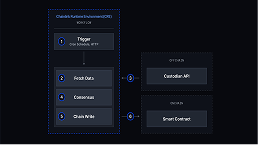
Custom Data Feed
See how you can bring your financial data onchain in a variety of different ways by creating a Net Asset Value feed, Proof of Reserve feed, or other custom data feed.
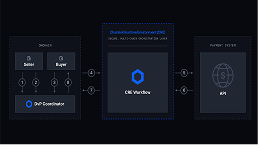
Delivery vs. Payment (DvP)
Learn how to sell a variety of assets via a Delivery vs. Payment transaction using the Chainlink Runtime Environment (CRE).
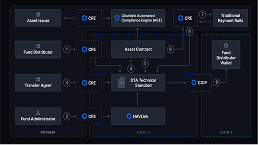
Digital Transfer Agent (DTA)
Learn how to invest in a variety of funds via a Digital Transfer Agent (DTA) transaction using the Chainlink Runtime Environment (CRE).

Explore Chainlink
Explore how the Chainlink standard powers tokenization and onchain finance through

Community Events


